How Diamonds are Made?
Diamonds are considered a symbol of love, status and strength. They're also very old, shiny underground rocks.
A rock found deep in the Earth's crust, travelling around the world to end up as your favourite piece of jewellery.
Let's follow that journey from 100 miles underground.
Made by Jaydip Sanghani
Formation
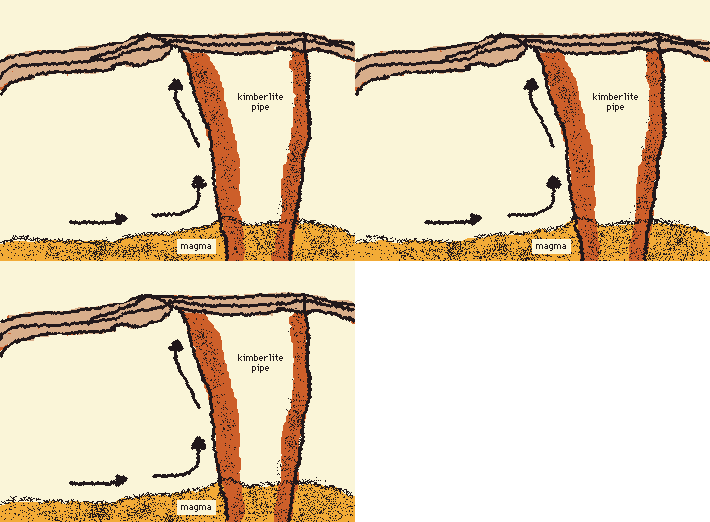
Deep underground below the crust of Earth, The pressure of 10,000 elephants and the temperature of lava are creating a chemical reactions with rocks. These rocks, called kimberlite rise to the surface with magma eruptions. Moving at incredible speed it forms the shape of a 'pipe'.
These kimberlite pipes are the most significant source of diamonds. It is estimated that only 1 in 200 kimberlite pipes contain gem-quality diamonds. Most natural diamonds have ages between 1 billion and 3.5 billion years.
Now, we need to find a way to take them out.
Mining
Kimberlite contains magnetite, which on magnetic surveys can reveal buried pipes that are completely invisible on the surface. LiDAR sensors mapping, and geochemical analysis is done using drilling to assess the location.

Once a promising site is found, drill cores are analyzed to calculate carats per tonne to decide if it's even worth it. Heavy machinery starts clearing the land and begins digging. Explosives are set and detonated to break apart large ores. Diamonds survive the blast as kimberlite is softer than diamond.
Now, we need to verify the quality.
Sorting & Cleaning
Rough rocks arrive at cleaning facilities. It includes lots of dirt, minerals and other debris. Now, it is bath time.
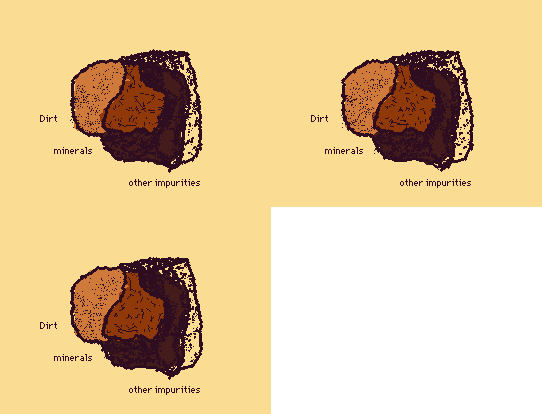
These rough ores are submerged in baths of sulfuric acid and boiled. Of course, diamonds come out completely unharmed while the surrounding dirt is dissolved.
From here, there are two rounds of sorting: gem quality and industrial grade. Most of mined diamonds never become jewellery. They go to cutting tools, drill bits, and grinding equipment.
These sorted diamonds are now ready for a flight to Antwerp, Belgium, where an estimated 80% of the world’s rough diamonds are traded. From here, our diamonds arrive at the city of “Surat” for one of the crucial steps.
Polishing
We have arrived at Surat /સુરત/, India.
Around 91% of the world's diamonds are polished here. Polishing an almost humongous amount of diamonds earning the title "Diamond City" /હિરાનગરી/
Around 5000 factories ranging from small family workshops to massive, high-tech units handle the large flow of this dying craft. Skilled artisans take the rough diamond and through multi-stage planning create cutting plans.
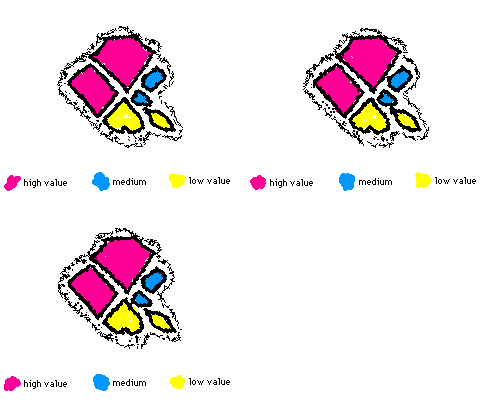
Every piece is scanned and a computer generates a rough estimate of how many diamonds we can fit in this piece. We have color coded diamonds from their shape and value to give a better idea. It gives us maximum utilization down to small pieces. Remember, even a small one is worth thousands.
We mark each piece with marker and plan a diagram for each shape. These are sent to artisans, who carefully press the diamond against a rotating diamond wheel. For each press it's carefully inspected with a tiny magnifying glass.
This phase is the most important, as the skills required to polish a very tiny face on a small piece of rock is hard. Doing this 100 times, everyday for a single piece is grueling. Every diamond goes through this painstaking process to achieve it's magnificent look.
Grading
Independent gem labs receive polished pieces to analyze, grade and certify diamonds with a report. These labs provide the unbiased third-party reports determining if a stone is natural or synthetic (lab grown).
Diamonds are graded on the 4Cs : Cut, Color, Clarity and Carat.


Here, Carat which is weight of diamond. Where, 1 carat equals to 0.2 grams.
Taking all this info we get a diamond report. Each diamond is given a unique number inscribed with a laser on its girdle. It is a very small (microscopic) number not visible to the naked eye. You can verify the authenticity of your diamond with this number.

Last Step
We Leave Surat /સુરત/.
Polished diamonds are sent to Mumbai with century-old informal trading system - Angadia /આંગડીયા/
Sellers trade diamonds in hubs like Mumbai, Antwerp, and Dubai. Every Diamond is priced against the standard “Rapaport” Price List . Ultimately, we reach the jewellers.
Jewellers would set the fine Diamond into jewellery or keep it as whole piece. The customer purchase the piece and receive the authenticity & grading with a report of its journey.
Our Diamond is now ready.